

Compliance Requirements for Stainless Steel Water Bottles Sold in Japan
Entering the Japanese market with stainless steel water bottles requires strict adherence to local food contact material regulations. Japan has a well-established legal framework to ensure product safety, especially for items that come into direct contact with food and beverages. For manufacturers and exporters like those at Yongkang Lishengli Trading Co., Ltd. (also known as Yongkang Junqi Cup Industry Co., Ltd.), understanding these compliance requirements is essential for successful market entry.
1. Food Sanitation Act (FSA) Compliance
The primary regulation governing food contact materials in Japan is the Food Sanitation Act (Act No. 233 of 1947). Under this act, stainless steel used in food contact applications must meet specific compositional and migration limits. The Ministry of Health, Labour and Welfare (MHLW) sets specifications for materials such as metals, including stainless steel. For stainless steel, the key requirements include limiting the release of harmful substances like lead, cadmium, arsenic, and chromium. Testing must be conducted in compliance with MHLW Notification No. 370 (as amended) and related official methods.
2. Voluntary Standards and Industry Guidelines
In addition to legal requirements, the Japanese Stainless Steel Association and the Japan Thermos Industry Association have established voluntary quality standards. Many major Japanese retailers and distributors request proof of compliance with these standards, which often cover thermal insulation performance, leakage resistance, and mechanical durability. While not legally mandatory, meeting these standards significantly boosts market acceptance.
3. Labeling and Display Requirements
Under the Food Labeling Act and the Household Goods Quality Labeling Act, stainless steel water bottles sold in Japan must have clear labels indicating the material composition (e.g., stainless steel type such as 304 or 316), the manufacturer's name and address (or importer's), and usage precautions. For products intended for children, additional safety warnings may be required.
4. Testing and Documentation
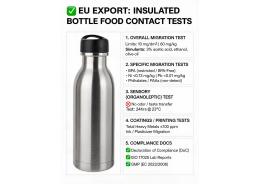
To prove compliance, suppliers must provide test reports from accredited laboratories. The typical tests required for stainless steel water bottles include:
- Heavy metal migration tests (lead, cadmium, chromium, nickel, etc.) using 4% acetic acid as the food simulant, per Japanese official methods.
- Overall migration tests for non-volatile residues.
- Sensory tests for odor and taste neutrality.
These reports must be in Japanese or accompanied by a certified Japanese translation. Also, manufacturers should maintain a technical file that includes a declaration of conformity and supporting documentation.
5. Compliance for Importers and Manufacturers
Importers in Japan are legally responsible for ensuring that the products they bring into the country comply with the Food Sanitation Act. This means they must obtain a notification or approval from the MHLW prior to commercial shipment, depending on the product's risk classification. For stainless steel water bottles, an approval is typically not required, but a notification of the manufacturer's facility may be necessary.
6. How Our Company Ensures Compliance
As a leading stainless steel thermos cup manufacturer with a 20,000㎡ production base and a daily output of 20,000 units, Yongkang Lishengli Trading Co., Ltd. is committed to meeting international quality standards. We support our clients in Japan by providing:
- High-quality 304/316 stainless steel with mill certificates confirming raw material composition.
- Customized testing solutions with certified third-party laboratories for Japan-specific migration tests.
- Complete documentation packages including test reports, declarations of conformity, and material statements.
- OEM services that adapt your product design to meet Japanese labeling specifications.
For more information about our stainless steel water bottles and their compliance features, please visit our factory in Yongkang, Zhejiang, China, or contact us at [email protected] / +86 18767975667.
Conclusion
Compliance for stainless steel water bottles in Japan is centered on the Food Sanitation Act, material migration limits, and proper labeling. Working with a manufacturer that understands these requirements can simplify the process. Our company is dedicated to delivering safe, compliant, and high-quality thermos products to the Japanese market.

 English
 German
 French
 Russian
 Spanish
 Japanese
 Korean
 Portuguese
 Ukrainian
 Arabic
 Italian


