

I. The Scientific Beginning: Dewar's Vacuum Flask
In 1892, Scottish physicist and chemist Sir James Dewar dedicated himself to research in cryogenics. He required a vessel capable of long-term storage of cryogenic media like liquid oxygen and hydrogen. These substances possess extremely low boiling points and rapidly vaporize at ambient temperatures, rendering ordinary containers utterly inadequate.
Thus, Dewar designed a revolutionary container: the Dewar flask. Its structure was ingenious and effective:
→ It featured a double-walled glass vessel with a high vacuum between the layers, greatly suppressing heat conduction and convection;
→ The inner glass wall was coated with a silver film, effectively reflecting thermal radiation and further blocking heat exchange;
→ The bottle opening was sealed with a stopper to minimize air circulation.
This invention served scientific experiments perfectly, yet it remained a fragile and costly instrument, not yet integrated into everyday life.
II. From Laboratory to the World: The Birth of Thermos
The true turning point came in 1904. Two German craftsmen—Reinhard Boeger and Albert Aschenbrenner—keenly recognized the Dewar flask's potential for civilian use. They refined the design by adding a metal shell, rubber gaskets, and a more user-friendly lid to the glass inner vessel, making it sturdy and leak-proof.
What followed was a classic business move: they held a public contest to name the product, ultimately selecting the Greek word “θερμός” (thermos, meaning “heat”) as the brand name. The word Thermos proved so resonant that for a long time afterward, it became synonymous with all insulated containers.
In 1907, Thermos established a subsidiary in the United States, and the vacuum flask quickly swept across Europe and America. People used it to preserve hot water, ice cream, and even hot soup—the scientific instrument had officially transformed into a household tool.
III. The Material Revolution: The Dawn of the Stainless Steel Era
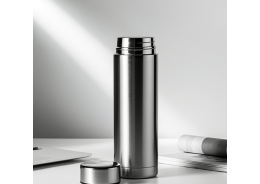
The original vacuum flasks never fully overcame the inherent fragility of their glass inner containers. It wasn't until the 1960s, with the maturation of stainless steel stamping technology and high-vacuum brazing techniques, that stainless steel vacuum flasks made their historic debut.
Stainless steel liners offered greater lightness, strength, and corrosion resistance, while maintaining comparable insulation performance. From then on, thermoses became truly portable and durable, expanding their use from households to outdoor activities, offices, vehicles, and beyond.
IV. Cultural Temperature: What Lies Within the Cup in East and West
Interestingly, in East Asia—particularly China, Japan, and Korea—thermos flasks carry deeper cultural significance. Chinese people favor hot water and tea, Japanese value the temperature of their bento boxes, and Koreans often drink ginseng tea and rice water. Here, the thermos transcends mere functionality, becoming a vessel for health practices and daily rituals.
In the West, however, it is more closely associated with coffee culture and outdoor activities, symbolizing both pragmatism and environmental consciousness.
Conclusion: Technology Ultimately Returns to Humanity
From Dewar's laboratory to the palm of your hand, the thermos's evolution exemplifies the journey of “technology becoming part of daily life.” It reminds us that many great inventions were not initially designed for everyday use, yet what truly changes the world is their ability to illuminate the subtle details of ordinary people's lives.
Today, when we unscrew the lid and steam rises, we hold not just a warm drink, but a century-spanning history of warmth where science and humanity converge.



 English
 German
 French
 Russian
 Spanish
 Japanese
 Korean
 Portuguese
 Ukrainian
 Arabic
 Italian


