

Design Restrictions & Guidelines for Custom Drinkware Shapes & Sizes
In the booming world of personalized and branded drinkware—from custom flasks to promotional tumblers—designing a unique shape or size might seem limitless. However, creating functional, safe, and manufacturable custom drinkware requires balancing creativity with practical constraints. Let’s explore the key guidelines and restrictions shaping your custom drinkware project.
1. Material-Driven Design Limitations
The choice of material (stainless steel, plastic, ceramic, glass, etc.) dictates fundamental design boundaries. Here’s how:
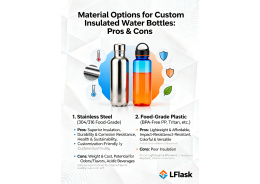
- Stainless Steel: Popular for insulation, stainless steel offers durability but has limits in form complexity. While malleable, intricate curves or ultra-thin walls can compromise structural integrity (e.g., a 2L stainless steel flask needs robust walls to avoid warping). Large sizes are feasible but add weight, impacting portability.
- Plastic (e.g., Tritan, PP, ABS): Lightweight and moldable, but heat resistance (for hot drinks) and structural strength limit size (e.g., a 1L plastic tumbler may sag under its own weight if walls are too thin). Complex undercuts or sharp angles in molds can increase manufacturing costs or cause defects.
- Ceramic & Glass: Aesthetically pleasing but brittle. Ceramic favors simple, symmetrical shapes (e.g., classic mugs) to avoid stress fractures; glass drinkware struggles with narrow necks or irregular curves (risk of cracking during thermal shock or handling).
2. Functionality: Prioritize Core Use Cases
Drinkware exists to work—whether it’s keeping coffee hot, resisting leaks, or fitting in a backpack. Functional requirements impose strict design rules:
- Insulation Performance: Vacuum-insulated flasks (like those at lflask.com) rely on a double-wall structure with a vacuum layer. This requires a consistent wall thickness and minimal structural gaps, limiting extreme tapers or irregular shapes that could disrupt the vacuum seal.
- Leak-Proof Design: Lids and seals must mate perfectly with the cup body. A custom lid’s thread pattern, diameter, and height must align with the cup’s opening—too tight/loose = leaks. Irregular rim shapes (e.g., non-circular) make leak-proofing extremely challenging.
- Portability & Usability: Handheld comfort (e.g., 2.5–3.5” diameter for most adults) and compatibility with cup holders (standard 2.75–3.25” diameter) restrict size. Oversized or oddly shaped drinkware may not fit in bags, cars, or office cup holders.
3. Manufacturing Process Constraints
How your drinkware is made (injection molding, blow molding, stamping, welding, etc.) defines what’s possible:
- Injection Molding (Plastic/Stainless Steel): Requires molds with draft angles (slight tapers) for easy part removal. Complex undercuts (e.g., internal grooves) or undercuts without ejector pins increase mold costs or cause defects. Uniform wall thickness is critical to avoid warping.
- Stamping & Welding (Stainless Steel): Stamped metal parts (e.g., tumbler bodies) struggle with sharp internal angles (stress points) or overly complex contours. Welded seams (e.g., for vacuum flasks) must be precise to maintain vacuum integrity—irregular shapes make welding inconsistent.
- Blow Molding (Plastic/Glass): Creates hollow parts (e.g., plastic bottles, glass jars) but limits wall thickness control. Asymmetrical shapes or thin walls risk collapse during cooling.
4. Safety & Regulatory Compliance
Custom drinkware must meet global safety standards (e.g., FDA for the US, LFGB for Europe) for food contact:
- Material Safety: Plastics must be BPA-free; metals must be food-grade (e.g., 304 stainless steel). Toxic glazes on ceramic or lead in glass are prohibited.
- Child-Safe Design: Kids’ drinkware requires rounded edges (no sharp corners), leak-proof lids (no choking hazards), and heat-resistant materials (e.g., double-walled stainless steel to prevent burns).
- Ergonomic Safety: Adult drinkware should avoid overly heavy sizes (e.g., a 1L glass tumbler is hard to lift) or unstable bases (prone to tipping).
5. Brand & Aesthetic Consistency
While creativity is key, custom drinkware should align with your brand’s visual identity (colors, logos, style):
- Logo Placement: Intricate logos or text require flat, smooth surfaces (e.g., a curved ceramic mug with a 3D logo may not print/engrave well). Size limits: logos too small lose visibility, too large disrupt aesthetics.
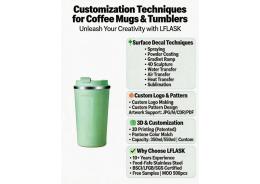
- Color & Finish: Material dictates finish options (e.g., stainless steel can be polished, powder-coated, or hydro-dipped; plastic can be injection-molded in color or painted). Metallic finishes on plastic may not adhere if the shape has rough textures.
- Style Cohesion: A luxury brand may favor minimalist, symmetrical shapes; an outdoor brand might opt for rugged, angular designs. Consistency across product lines (e.g., matching tumblers and flasks) requires shared design language (e.g., same rim shape, handle style).
6. Real-World Examples & Inspiration
Brands like LFlask balance creativity with practicality: their custom stainless steel flasks feature sleek, ergonomic shapes (easy to hold) with standardized lid sizes (universal compatibility) and food-grade materials. For example, a 500ml travel flask uses a tapered body for portability, while a 1L outdoor flask prioritizes ruggedness with reinforced walls.
For unique shapes, hybrid materials (e.g., stainless steel body + plastic lid) expand possibilities: the metal provides strength, while the plastic allows complex lid designs (e.g., flip-top, straw-compatible).
Conclusion: Balancing Creativity & Practicality
Custom drinkware design is a dance between innovation and constraints. By understanding material limits, manufacturing processes, safety standards, and user needs, you can create functional, beautiful, and market-ready products. Partner with experts (like LFlask’s design team) to navigate these guidelines—turning restrictions into opportunities for unique, purpose-driven drinkware.
Ready to bring your custom drinkware vision to life? Explore LFlask’s custom solutions to see how design, functionality, and compliance harmonize.

 English
 German
 French
 Russian
 Spanish
 Japanese
 Korean
 Portuguese
 Ukrainian
 Arabic
 Italian


